The Future of Digital Advertising: Agentic AI, Conversational Search, and Commerce Media
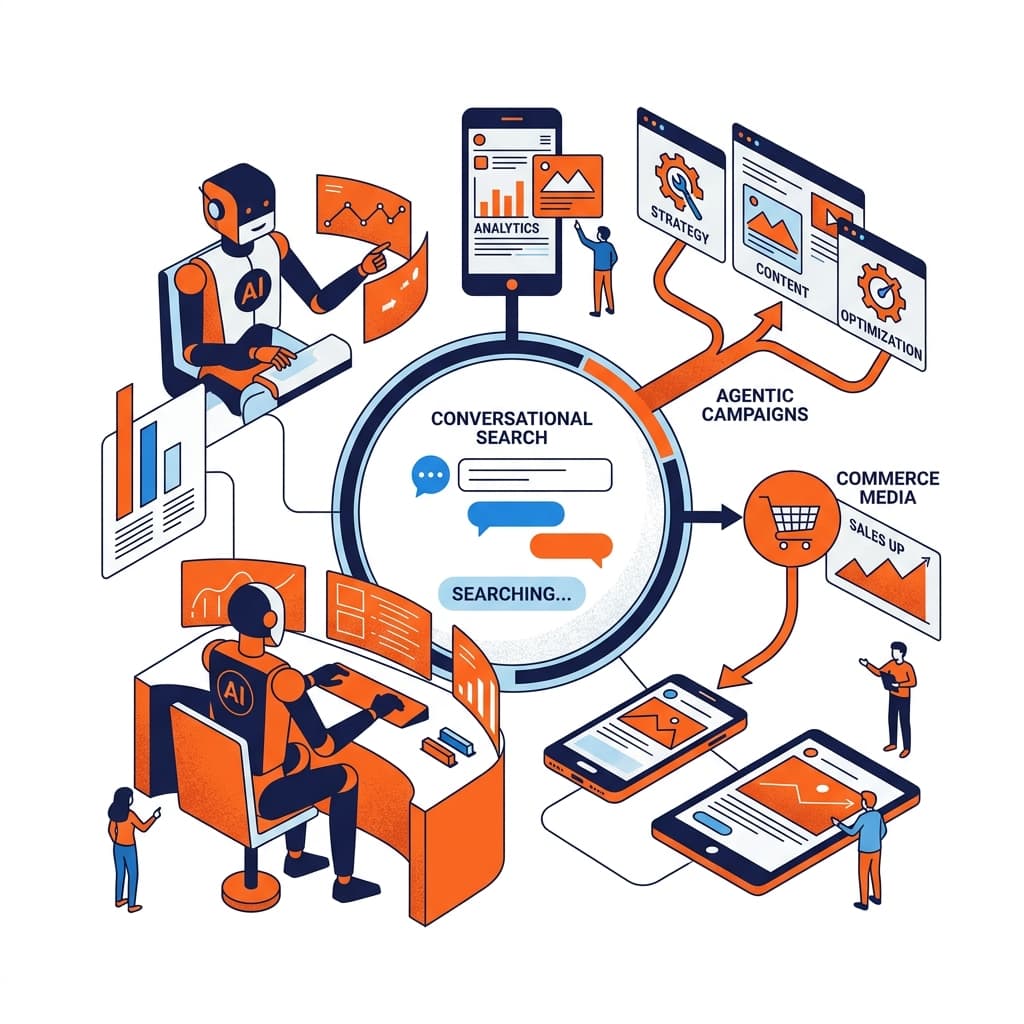
Digital advertising is entering a period where the biggest change will not simply be another social platform or ad format. The deeper shift will be in who or what makes advertising decisions, how consumers discover products, and how closely advertising becomes connected to an actual purchase. Based on current developments, I believe the three most significant changes over the next five years will be agentic AI in campaign management, AI-driven search and discovery, and the expansion of commerce media.
1. Agentic AI Will Move From Assistant to Campaign Operator
Generative AI has already made it easier to create headlines, images, videos, and advertising variations. The next step is much bigger: AI systems that can help plan, launch, analyze, and optimize campaigns with less manual intervention.
The Interactive Advertising Bureau (IAB) found that five of the six highest-priority areas for advertisers in 2026 involve AI, while approximately two-thirds of buyers are specifically focused on agentic AI for ad buying and campaign execution (IAB, 2026a). Google is moving in the same direction. Its new Ask Advisor connects information across Google Ads, Analytics, and other marketing tools to provide recommendations and assist marketers with campaign decisions (Google, 2026a).
Over the next five years, this could dramatically increase the speed of advertising. Instead of manually building a few campaign variations and checking them every day, marketers could give an AI system a goal, budget, brand guidelines, and performance constraints. The system could continuously test creative, redistribute spending, and identify new audiences.
This will not eliminate marketers. Instead, I believe the marketer's role will move upward toward strategy, brand judgment, creative direction, and oversight while AI handles more execution.
2. Search Advertising Will Become Conversational
Search advertising has traditionally been based on a fairly simple interaction: someone types keywords, receives results, and chooses a link or advertisement. AI search is changing that behavior.
IAB reports that 73% of marketers are already prioritizing content optimized for AI-generated answers (IAB, 2026a). Google has also reported that AI Overviews increased Google usage by more than 10% for the types of queries where they appear in major markets such as the United States and India (Google, 2025).
Google is now testing advertising specifically designed for this environment, including conversational discovery advertisements and AI-generated answers that can introduce consumers to relevant products while they are researching a problem (Google, 2026b).
This means advertisers may eventually compete for more than keywords. Brands will need to make their products, content, reviews, data, and offers understandable to AI systems that increasingly mediate the consumer's buying journey. Search marketing could therefore evolve from "How do I rank for this keyword?" to "How does an AI system understand and recommend my brand?"
3. Advertising and Shopping Will Become One Experience
The third major development will be the continued growth of commerce media: the combination of advertising, retailer data, product discovery, and purchasing.
IAB forecasts 12.1% growth in U.S. commerce-media advertising during 2026, substantially faster than the overall advertising market (IAB, 2026a). The industry is also moving beyond basic sponsored product listings. IAB describes commerce media as becoming a full-funnel ecosystem connecting media, measurement, customer experience, and increasingly AI (IAB, 2026b).
We can already see this convergence in video and creator advertising. Google introduced YouTube Affiliate Partnerships Boost, which allows brands to promote creator videos where products are directly tagged, connecting trusted content with a path to purchase (Google, 2026c).
Over the next five years, the distinction between seeing an advertisement and shopping will continue to disappear. A consumer may discover a product through a creator, ask an AI assistant questions about it, compare alternatives, receive a personalized offer, and complete the transaction without following the traditional advertising funnel.
Final Thoughts
The future of digital advertising will not simply mean more automation. Agentic AI will change how campaigns operate, AI search will change how consumers discover brands, and commerce media will change how advertising connects to purchases.
The competitive advantage will therefore shift toward brands that can combine strong creative ideas with high-quality data, intelligent automation, and experiences that genuinely help consumers make decisions. Technology will handle more of the mechanics of advertising, but marketers will remain responsible for deciding what the brand should say, why consumers should care, and where automation should stop.
References
Google. (2025, May 21). More opportunities for your business on Google Search. Google.
Google. (2026a, May 20). Meet Ask Advisor, your new AI-powered collaborator. Google.
Google. (2026b, May 20). A new generation of ads for the AI era of Search. Google.
Google. (2026c, July 9). Google Marketing Live 2026: Delivering the Gemini advantage for Indian businesses. Google.
Interactive Advertising Bureau. (2026a, January 28). 2026 outlook: A snapshot of U.S. ad spend, opportunities, and strategies for growth. IAB.
Interactive Advertising Bureau. (2026b). 2026 IAB Annual Leadership Meeting: Key takeaways. IAB.
DEVAL NATH
System Architect