Preliminary Findings and Limitations: Apple AirPods Sleep
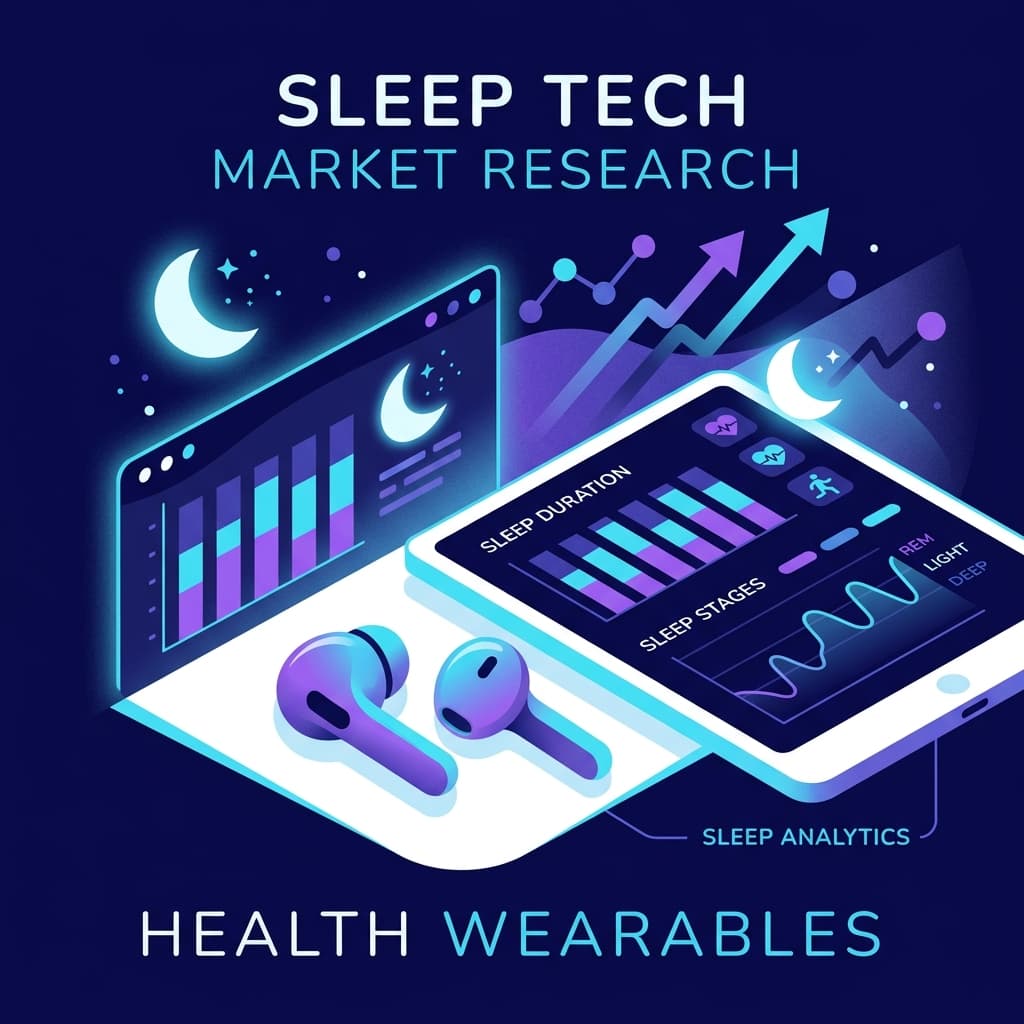
For my marketing research project, I am proposing Apple AirPods Sleep, a sleep-focused version of AirPods designed for comfortable overnight use. The concept would combine noise masking, relaxing audio, sleep tracking, a private alarm, all-night battery life, and integration with Apple Health. Based on the research completed so far, I believe there is a reasonable market opportunity for this product, although additional primary research and product testing would be necessary before making a final launch recommendation.
Preliminary Findings
The market research supports Apple's broader movement toward integrating health and wellness features into its technology ecosystem. Apple reported more than 2.5 billion active devices worldwide in January 2026, giving the company an unusually large installed base through which it could introduce a new ecosystem-connected product (Apple, 2026a). Apple has also continued expanding the health capabilities of its wearables. AirPods Pro 3 introduced heart-rate sensing, while Apple has added clinically validated hearing features to AirPods Pro and sleep apnea notifications to Apple Watch (Apple, 2025; Apple, 2026b). These developments suggest that consumers are increasingly being encouraged to view Apple devices as more than entertainment products.
There is also evidence of a meaningful consumer need. According to the Centers for Disease Control and Prevention, 30.5% of U.S. adults slept fewer than seven hours per day in 2024, while 15.4% reported difficulty falling asleep and 18.1% reported difficulty staying asleep (Ng et al., 2026). These findings support the idea that sleep represents a significant wellness concern for American consumers.
Competition also demonstrates that consumers are willing to purchase technology specifically designed for sleep. For example, Ozlo currently sells its Sleepbuds 2 for approximately $279, offering features such as a low-profile design for side sleepers, noise masking, sleep tracking, a private alarm, and up to 14 hours of battery life (Ozlo, n.d.). This validates many elements of my proposed concept while also showing that Apple would enter an established competitive category rather than creating an entirely new one.
My preliminary strategy would therefore position AirPods Sleep at approximately $299, emphasizing superior Apple ecosystem integration, comfort, privacy, and sleep-related functionality. Distribution would rely heavily on Apple's direct channels, including Apple Stores and the online Apple Store, along with selected authorized retailers. Promotion should focus on sleep wellness, convenience, noise reduction, and Apple Health integration rather than making medical promises.
Industry and Future Trends
One important trend is the convergence of consumer electronics and personal health technology. Wearable products are increasingly incorporating biometric sensors, personalized health information, and connected applications. AirPods Pro 3 already demonstrate this shift by incorporating heart-rate sensing alongside traditional audio functions (Apple, 2025). If this trend continues, consumers may increasingly expect headphones and other wearable devices to provide health and wellness benefits in addition to their original functions.
However, this trend also creates regulatory and ethical responsibilities. The FDA's updated guidance distinguishes certain low-risk general wellness products from products making medical claims (U.S. Food and Drug Administration [FDA], 2026). Apple should therefore market AirPods Sleep as helping consumers understand and support their sleep habits unless stronger medical claims have been appropriately validated. Similarly, Federal Trade Commission guidance requires health-related advertising claims to be truthful, not misleading, and supported by appropriate evidence (Federal Trade Commission [FTC], 2022). Sleep and health information should also be handled transparently because consumers may consider this information highly personal.
Limitations
The largest limitation of my research is that AirPods Sleep is a hypothetical product, so there is no actual sales history, customer usage data, or prototype testing available. My Module Five survey was designed to measure concept appeal, desired features, concerns, acceptable pricing, and purchase intention, but I do not yet have sufficient completed survey responses to treat those findings as representative primary research.
There are also gaps regarding overnight comfort, battery performance, sleep-tracking accuracy, and consumers' willingness to wear earbuds for several hours while sleeping. Secondary research can identify market trends and competitor activity, but it cannot fully predict how consumers would respond to an actual Apple prototype.
Therefore, my preliminary conclusion is that AirPods Sleep has enough strategic and consumer-market potential to justify further research, but not enough evidence yet to recommend an immediate national launch. The next stage should include prototype testing and a carefully selected U.S. sample to validate comfort, price sensitivity, feature preferences, and actual purchase intent before Apple makes a final launch decision.
References
Apple. (2025, September 9). Introducing AirPods Pro 3, the ultimate audio experience. Apple Newsroom. https://www.apple.com/newsroom/2025/09/introducing-airpods-pro-3-the-ultimate-audio-experience/
Apple. (2026a, January 30). Apple reports first quarter results. Apple Newsroom. https://www.apple.com/in/newsroom/2026/01/apple-reports-first-quarter-results/
Apple. (2026b, May 21). Groundbreaking health features available today on Apple Watch and AirPods Pro. Apple Newsroom. https://www.apple.com/in/newsroom/2026/05/groundbreaking-health-features-available-today-on-apple-watch-and-airpods-pro/
Federal Trade Commission. (2022). Health products compliance guidance. https://www.ftc.gov/system/files/ftc_gov/pdf/Health-Guidance-508.pdf
Ng, A. E., Black, L. I., & Adjaye-Gbewonyo, D. (2026). Short sleep duration and sleep difficulties among adults: United States, 2024. National Center for Health Statistics. https://www.cdc.gov/nchs/products/databriefs/db559.htm
Ozlo. (n.d.). Ozlo Sleepbuds 2. https://ozlosleep.com/pages/ozlo-sleepbuds
U.S. Food and Drug Administration. (2026). General wellness: Policy for low risk devices: Guidance for industry and Food and Drug Administration staff. https://www.fda.gov/media/90652/download
DEVAL NATH
System Architect